
Tattoo Removal Before and After
These before and after photos show real tattoo removal results from Face Figurati in Forest Hill, Melbourne. As a guide, cosmetic tattoos on brows and lips usually lighten visibly after 1–2 sessions and clear in 2–6, while body tattoos with black ink fade in stages over 5–10 sessions.


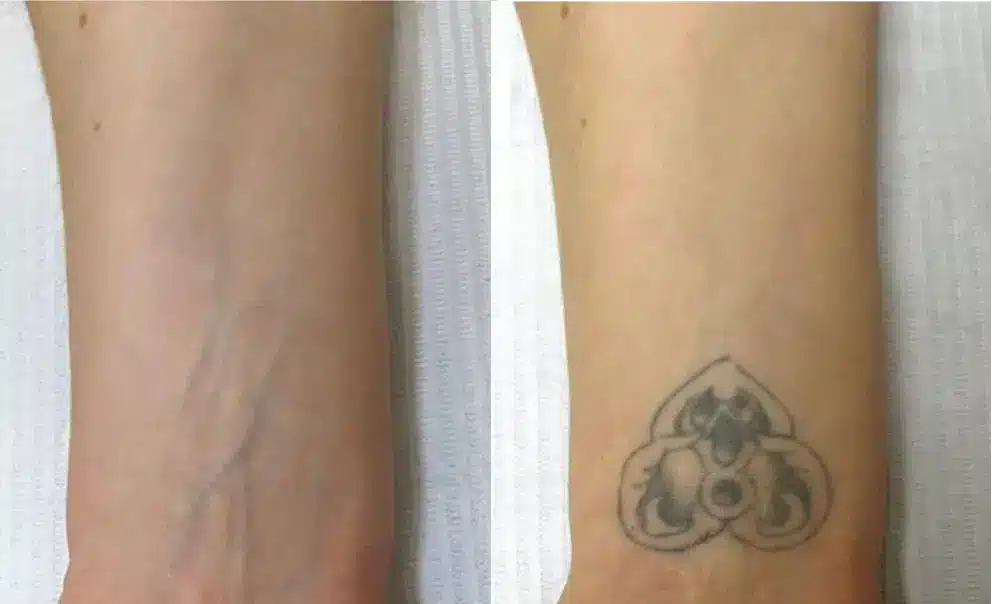
Tattoo removal stages: what changes after each session
-
- Straight after: the tattoo turns white (frosting) for 10–20 minutes, then looks red and slightly raised.
- Days 1–7: swelling, possible blisters and light scabbing; the ink can look darker while the skin heals.
- Weeks 2–6: the immune system clears broken-down ink and the tattoo looks lighter and patchier.
- After 3–4 sessions: black outlines break up first, while colours and shading fade later — and why colours take longer comes down to how each pigment absorbs laser light.
- Final sessions: faint shadows clear or remain as a “ghost” in very dense colour work.
Interval between removal sessions
We space sessions 6–8 weeks apart (8–10 weeks on lips and eyelids) so the skin heals fully before the next treatment. With eyebrow tattoo removal, warm pigments are often lightened with saline between laser sessions. Laser tattoo removal is a multi-step process that requires several treatments to properly lighten or remove a tattoo. The length of time between laser tattoo removal sessions can vary greatly, depending on the unique situation of each individual. In most cases, practitioners will recommend treatment intervals of 6-8 weeks apart in order to allow enough time for the body’s healing process while also achieving optimal results. Try taking tattoo removal pictures after one session to document your results. Factors such as skin tone, location on the body, how deeply and extensively the colors were applied, and how quickly your body heals all play a role in determining an appropriate interval for laser treatments. By spacing laser treatments at the ideal interval for your particular situation, you can get the best possible outcome from laser tattoo removal with minimal discomfort and downtime. Shortening the time between sessions will not speed up the process of before and after of tattoo removal.Why a laser is your best option
Tattoo removal is a process of laser light therapy designed to gradually fade away a tattoo, restoring the skin and giving it a more natural appearance. Many people have successfully undergone laser tattoo removal before and after treatments and have reported great outcomes.
For those looking to remove tattoos on their own, there are some products available online that claim to be effective at removing tattoos from the comfort of one’s home. However, such products come with no medical recommendation or approval, leaving users unable to verify their efficacy and safety.
Laser tattoo removal treatments are the most reliable and prescribed form of removing tattoos by medical professionals, as undergoing laser treatment will almost always result in better removal of a tattoo and is the best choice for sleeve tattoo removal.
But no need to worry, that’s okay! An experienced brow stylist would be able to show you what style works best to enhance your features.
Why a laser is your best option
Tattoo removal is a process of laser light therapy designed to gradually fade away a tattoo, restoring the skin and giving it a more natural appearance. Many people have successfully undergone laser tattoo removal before and after treatments and have reported great outcomes.
For those looking to remove tattoos on their own, there are some products available online that claim to be effective at removing tattoos from the comfort of one’s home. However, such products come with no medical recommendation or approval, leaving users unable to verify their efficacy and safety.
Laser tattoo removal treatments are the most reliable and prescribed form of removing tattoos by medical professionals, as undergoing laser treatment will almost always result in better removal of a tattoo and is the best choice for sleeve tattoo removal.
But no need to worry, that’s okay! An experienced brow stylist would be able to show you what style works best to enhance your features.
Look at the benefits
Getting a laser tattoo removal procedure for your tattoo is the safest and most effective way of ensuring it disappears. Lasers are powerful light sources that target your tattoos’ pigmentation, breaking it up into tiny particles which can be eliminated by the body’s natural healing system.
This makes laser tattoo removal far more efficient than trying to do it yourself using home products, which often result in a more difficult, slower, and less effective removal process. Additionally, laser tattoo removal is performed in a medical setting, meaning that safety measures are taken to make sure everything goes as smoothly as possible. So why not let the professionals use their laser treatment on you for lasting results?
What to expect before and after tattoo laser removal
It is important to be prepared for what will happen to your skin and tattoo after removal. Prior to laser tattoo removal, the area that has been marked must be thoroughly examined by a professional in order to develop an appropriate action plan.
Expect laser treatments to be spaced out over several weeks or months depending on the size of the tattoo and its colour profile. After each laser treatment, expect for the area that has been lasered to feel tender and look slightly inflamed – akin to having a sunburn – until it healed.It is imperative that laser treated skin is kept moisturised at regular intervals in order to expedite its healing process and diminish any risk of infection.
Preparing for a Laser Tattoo Removal Session
No special preparation is required for the tattoo removal process procedure, but some points do need to be observed:
- Temporarily exclude the possibility of exposure to ultraviolet light on that particular area of the skin to be treated. It may become more sensitive to the laser.
- It is advisable to reduce the dose of nicotine consumed.
- Do not use any medications that affect the skin.
- It is worth postponing treatment if there are wounds or inflammations on the skin.
Healing Time
Expect that the skin will redden immediately after the session. There could be some puffiness and swelling. This is a typical skin reaction that will go away in two to three days. To set your expectations, you can check some tattoo removal photos before the session. Crusts may start forming on days 6-7. Then, they start to turn brown and peel off after a week. Never attempt to peel them off as you might cause damage to your skin. Once the crusts fall off naturally, you can expect your skin to have a pinkish tinge underneath. Color lightens completely after 1-2 months as the skin regenerates.
Good To Know
Laser tattoo removal is considered safe, but some discomfort and slight redness may occur after the procedure. The reaction passes fairly quickly and should not be a cause of concern. The best thing to do is to follow your practitioner’s laser tattoo removal aftercare recommendations.
Usually, the critical period does not last more than two weeks. During this period one can apply soothing creams, one should not scratch or rub the skin, one should not expose it to sunlight and one should limit the use of cosmetics. It is not advisable to play active sports, go to the swimming pool, sauna or sauna. In other words, avoid exposing the skin to extreme temperatures and moisture.
If you follow the recommendations, the final recovery process will be quick and comfortable.
What Does the Skin Look Like After Tattoo Removal?
Aside from mild pain and discomfort after the session, you may experience swelling or redness on the skin where the tattoo is located. You may also see white blisters or capillary bleeding. After a day, the white blisters will crust over, which is strictly forbidden to touch. These crusts will fall off on their own, replacing them with new, healthy skin in a few weeks. After another 5-7 weeks, you will notice that the tattoo has lightened and the skin has returned to normal.

Why Our Studio?
FAQ
Can a tattoo be completely removed?
Lasers are a safe and effective method for removing tattoos completely, although multiple sessions may be required for full removal.
Do tattoos completely disappear after removal?
While techniques like laser or saline removal can significantly fade them, some traces—like shadowing or slight discoloration—often remain, especially with deep or colorful ink.
How painful is tattoo removal?
Laser tattoo removal can cause discomfort, with pain levels similar to that of a bad sunburn. The sensation of the laser pulses is often described as feeling like a rubber band snapping against the skin.
Can a tattoo be removed in 3 sessions?
The number of laser treatments needed to remove a tattoo can vary depending on factors such as ink type, depth, and colors used. Amateur tattoos may take 3 to 7 sessions, while professional tattoos may require 8 to 20 treatments or more.